

The Accidental Racecaller
Updated: August 29, 2015 at 1:06 pm
By Lucas Marquardt
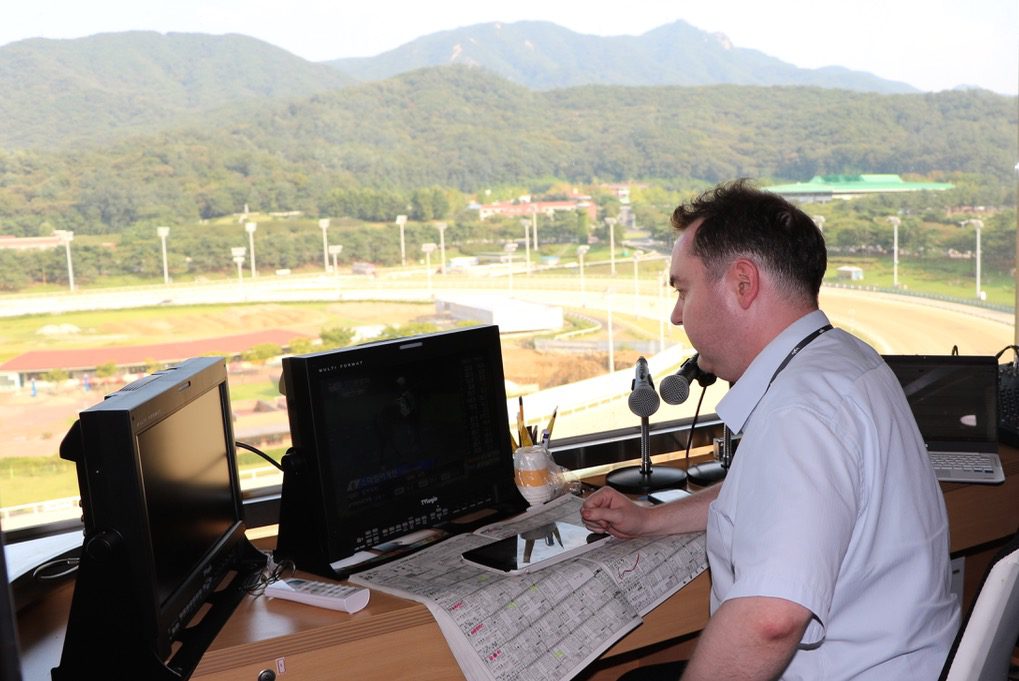
Decide what you love and find a way to make a living at it. That’s advice many of us got as we were starting out in the world. Alastair Middleton, a British expat living in Seoul, definitely had the first part figured out. The second, well, that was more serendipity than anything.
Middleton is the English-language racecaller at Seoul Race Park. He’s also the man behind Horse Racing in Korea, a blog that is one of the few sources of Thoroughbred news here not in Korean. That–in addition to being well-written and concise–has made the blog immensely popular with fans around the world trying to learn more about Korean racing.
“I came to Seoul 2006, having worked in insurance back in England,” said Middleton. “But I figured I had my whole life to work in insurance, so I came here to teach English. My hobbies back home were football and racing, and my hobbies in Korea turned out to be…football and racing. So I started the blog, and it was a lot of fun.”
Middleton began his blog in late 2007, and at the time had no contact with the Korea Racing Authority. Six years later, however, an interview was requested, and the KRA asked if they could use some of his content on the KRA’s new English-language site. Middleton said no problem. It was the next request from KRA that was the problem.
“They rang me a few weeks before the Grand Prix, which is the season-ending race here in December,” Middleton continued. “It’s Korea’s most important race, and similar to the Arima Kinen in Japan in that punters can vote on which horses compete. They asked if I knew how to call a horse race. It turns out the Grand Prix was going to be broadcast in Singapore for the first time, and they needed a caller. I said, ‘No, I don’t, and it’s really, really hard. You should get a professional.’”
That, Middleton thought, settled the matter. But then three days before the Grand Prix, he got another call.
“They said, ‘Well, do you think you COULD call a race?’” Middleton laughed.
So with no experience, calling the country’s biggest race, and facing a crowded 16-horse field, Middleton got behind the mic and gave it his best. And his best was…?
“It was pretty terrible,” he laughed.
It couldn’t have been too bad. Six months later, the KRA called once again, this time asking Middleton to call races full time at Seoul for the Singapore simulcast. For a time, Middleton juggled racecalling, blogging and a full-time job (he had landed as the HR director for a language company), but last year, was able to devote all his time to racing. That’s no small chore. Seoul races twice a week, 50 weeks out of the year, with between 10 and 12 races on each card, typically. Middleton also calls races at Busan, Korea’s other Thoroughbred track. Busan is Korea’s second-largest city, located in the southeast corner of the country and about four hours by train. That means Middleton has to call the races by watching a monitor at Seoul.
“It’s pretty interesting, since you can generally only see the first few horses,” he admitted. “But if you listen to the Korean racecallers, they generally only call the first four or five horses anyway.”
Middleton’s job is made slightly easier by the fact that the jockeys here wear their own colors, rather than the owner’s.
“And their caps are the same color as the saddle towels, and that helps. But listen–I’m still a terrible caller. There’s no way I’m a trained professional. But it’s a lot of fun.”
Middleton added, “It’s the hardest thing I’ve ever done. This sounds rather arrogant, but I was always accustomed to being pretty good at my job. To suddenly come into something where I wasn’t good at, it is a challenge.”
In the meantime, Middleton still maintains his blog diligently. A lot of the time, that means fielding requests from American fans.
“I get a lot of people asking about horses that had been sold here,” he said. “I can read a little Korean, and I’m happy to track them down. It’s actually very rewarding. Because of the price limit set by the KRA on foreign purchases, the horses that were imported here were often the product of smaller, less commercial breeding operations. They were breeders who bred maybe one or two horses a year, and they tend to be the ones who follow their horses very closely.”
In addition to calling races for the KRA, he’s part of their International Marketing Team. Part of that job entails arranging for foreign visitors to watch races at a suite at Seoul Race Park dedicated to that purpose.
“We had a group of 35 ex-pats from the embassy a few weeks ago, and one guy won $8,000 in his first-ever bet,” said Middleton. “It was a $10 bet–he just bet his birthday, 3-1. He was ordered directly home by his wife afterward.”
Last week, things got interesting at the track due to the escalating tension between North and South Korea.
“We get the periodic threat from our good neighbors to the north, but to be honest, no one here generally cares,” Middleton said. “When someone’s been pointing a gun at your head for 60-odd years, well. There was, however, a newsflash here on the tote board last week about it, saying that tensions were easing and talks were planned. What it meant was, ‘Keep betting. If you’re wife’s calling telling you to come home, tell her it’s going to be okay.”
As both an insider and an outsider, Middleton has had a unique view of the progress Korean racing has made.
“I like the direction the KRA is going in,” he said. “They’ve really started to take improvements seriously, and to take the internationalization seriously. It’s an interesting time in Korean racing, and it’s exciting to be part of that.”
He concluded, “Listen, the infrastructure is great, the handle is great, the racing is developing. There’s a long way to go, but we’re certainly moving in the right direction.”
Some Non-Racing Throughts…
After an overcast Friday spent mostly indoors, due to a) a massive interview transcription; and b) some other-worldly jet lag, Saturday broke cloudless and brilliant in Seoul. The weather here isn’t all that different than in Kentucky. The summers are hot, the winters are cold, but things rarely go too far in either direction.
I got up at 6 and ventured out of the hotel to find a coffee shop on the nearby streets of Gangnam. I found a few, but nothing open, and thought of bloodstock agent Chad Schumer when I finally relented and stepped into a McDonald’s. I was having dinner with Chad and the writer/agent Nancy Sexton one time when Chad mentioned that he liked a TDN blog I’d done. It was about the different meals I’d had in Hong Kong. I admitted I wasn’t a foodie, not really, and that if it wasn’t for the caloric implications, I’d eat fast food ALL the time. The look on Chad’s face was a mix of disappointment and slight betrayal. He was sad for me, and it showed. I thought about that look as I finished up my Egg McMuffin, which, I can report, is equally delicious on this continent.
Given my breakfast choice, however, I figured it would probably be wise to head to the hotel gym later that morning. I had gone the day before and noticed a few things. The place was huge and very nice. There were maybe 25 treadmills, an equal number of bikes, plenty of Nautilus machines, and even a couple vibrating plate doohickeys. I’d never been on one–I know some horse farms swear by them–and found that if you crank them up to 10, you can literally feel your brain being concussed. Other things I noticed: video of the family of bears that raided that swimming pool in New Jersey has found its way onto Korean news. And most everyone was much older than the people you’d typically find in hotel gyms in the U.S. Seventy was maybe the mean age. I thought maybe this was because the septarian set took fitness more seriously here. Later, I asked someone about it. They informed me that, while that may be the case, membership to hotel gyms like this were very much a status symbol, and were wildly expensive. Intrigued, I inquired this morning to a pleasant young lady about joining. She very professionally brought out a folder detailing the different memberships. It was…a lot. Tens of thousands of dollars, a lot.